Looking for bathtub reglazing in Temecula? Adamov Reglazing restores fiberglass, acrylic, porcelain, cast iron, and cultured marble surfaces across Temecula and southwest Riverside County — ready to use in about 7 hours, backed by a 4-year warranty, with no hidden costs.
Temecula’s growth from the 1990s onward means most bathrooms here have fiberglass and acrylic units, with older homes closer to Old Town carrying porcelain and cast iron tubs. We also see plenty of the less common units — molded faux-tile fiberglass surrounds, cultured marble vanity tops — that not every shop is set up to handle. Whatever the material, if the fixture is structurally sound, the surface can be restored in a single visit.
We handle:
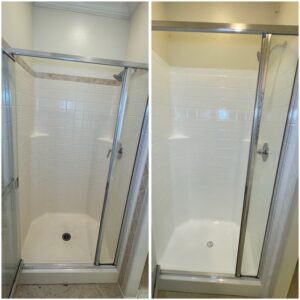
Here’s the last reglazing project we completed in Temecula, and it was a pretty unique one — a fiberglass shower with fake tile walls. If you’ve never seen one, it’s a molded fiberglass unit cast with a tile pattern, grout lines and all, made to look like a real tiled shower without actually being tile. They’re not a common unit, and they call for a slightly different approach than a smooth fiberglass wall.
We started with a deep cleaning, and on a unit like this the cleaning takes extra attention. Those molded tile lines look just like real grout lines and behave like them too — they’re recessed, so they collect the most grime. Soap scum, body oil, and hard water residue settle down into the grooves where a quick wipe never reaches. So we brushed each tile line individually, working the buildup out of every channel across the walls. Leave that grime sitting in the grooves and the coating has something fighting it from the start.
Then the damage: a couple of chips on the walls, most likely from something sharp getting dropped. We filled those with fiberglass filler, building them back solid and flush so they’d vanish under the new finish. It matters even on walls — an open chip lets water start working into the fiberglass over time.
After the repairs, new caulking along the shower rail and around the whole unit, sealing the seams where water tries to get behind the surface. Then the room masked, our commercial ventilation set up to pull fumes and overspray out of the house, and several coats of commercial-grade bright white polyurethane, built up rather than laid on in one heavy pass.
Here’s the part people wonder about with these units: the coating flows over the molded tile pattern and leaves the texture intact. It still reads as tile — just crisp and bright white now instead of dull and grimy. The whole bathroom feels fresher for it.
Most people don’t know, and it genuinely changes how the job is done — the prep, the repair materials, and what’s realistic to expect. Here’s how to tell.
Cast iron with porcelain enamel Very heavy and rigid — it doesn’t give at all when you step in. Tap it and you get a dull, solid thud. A magnet sticks. If it’s chipped, you’ll see dark grey or black metal at the bottom of the chip, sometimes with rust. These are the best tubs in most houses, they last generations, and they’re always worth restoring. Rust has to be ground out to clean metal and sealed before anything is sprayed.
Porcelain enamel over steel A magnet sticks to this one too, but it’s much lighter than cast iron and sounds tinnier when tapped — more of a ring than a thud. Chips show lighter grey metal. Very common in mid-century and rental construction. Refinishes well; rust at chips and around the drain is the usual issue.
Fiberglass Flexes slightly underfoot and sounds hollow when tapped. Chips reveal a fibrous, whitish-yellow layer under the glossy top coat. That glossy top layer is thin, which is why fiberglass dulls and stains once it wears through. Needs light sanding and a bonding primer; a flexing floor may need structural foam underneath before coating.
Acrylic Also flexes, but feels slightly warmer to the touch than fiberglass and the color runs deeper into the material rather than sitting as a thin surface layer. Takes coating very well. Sands easily — which means it’s also easy to sand too aggressively if someone isn’t paying attention.
Molded faux-tile fiberglass (like the unit in this job) Looks like a tiled surround, but run your hand over it: the “grout lines” are recessed channels in one continuous piece, with no grout texture and no individual tile edges. There’s nothing to regrout, and no tile to replace — it’s treated as one fiberglass surface, with extra attention to cleaning out those channels.
Cultured marble Usually vanity tops rather than tubs. Heavy, with a swirled or veined pattern molded through the surface, and typically an integrated sink. Refinishes well and is a great candidate for updating a dated bathroom.
Not sure? Send us a photo, ideally including a close look at any chip. We can almost always tell from that — and knowing the material is how we give you an accurate quote instead of a guess.
Every job finishes the same way: we hand over a post-care kit and our cleaning recommendations, and the work is backed by our 4-year warranty.
This job was in Temecula, and we cover the neighboring cities just as easily — Murrieta, Menifee, Wildomar, Winchester, and Fallbrook.
Chips, grimy molded grout lines, dull surfaces, dated colors — whatever you’ve got, call (310) 401-4491 and we’ll tell you honestly whether reglazing is the right move.
For more information you can check out our Blog or FAQ.