Looking for bathtub reglazing in Stanton? Adamov Reglazing restores porcelain, cast iron, fiberglass, and acrylic tubs across Stanton and west Orange County — ready to use in about 7 hours, backed by a 4-year warranty, with no hidden costs. Reglazing instead of replacing saves thousands of dollars and days of demolition mess.
Stanton’s housing is largely 1950s and 60s, with a high share of rentals, duplexes, and mobile home communities. That means two things we see constantly: original porcelain-coated cast iron tubs that have started to rust where the enamel chipped, and cheap previous reglazes that peeled within a year or two. Both are fixable — but rust has to be ground out and sealed properly, not sprayed over.
We handle:
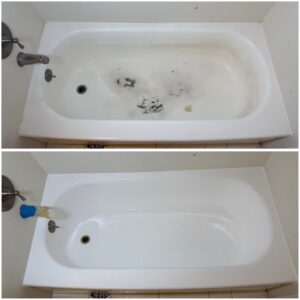
Finished up a tub reglazing job in Stanton recently that was a little more involved than usual because we were essentially redoing somebody else’s work. This is something we run into more than you might think. A homeowner gets their tub reglazed by a low-priced outfit, the finish lasts a year or two, then it starts peeling and they call us to fix it. It’s almost always the same story underneath: the original company skipped steps on the prep, and the coating had nothing to grip onto for the long haul.
This particular tub was a porcelain-coated cast iron tub, the kind you’ll find in plenty of older Stanton homes. Heavy, well-built, the kind of tub that lasts forever if you take care of the surface. The previous reglazing had failed pretty badly. The bottom of the tub was peeling in sheets, and underneath the peeling coating we could see what was really going on: rust. Several rust spots had developed under the old finish, and once rust gets going under a coating, it lifts the coating right off the metal. That’s why the finish had failed. The previous company had either ignored the rust spots entirely or just sprayed over them and hoped for the best.
First step was sanding down the old coating. We had to get all of it off, not just the parts that were already peeling. Any old finish left behind would become a weak point under our new coating. So we took the whole bottom of the tub down to a clean base, working carefully so we wouldn’t dig into the porcelain or the cast iron underneath any more than necessary.
Once the old coating was gone, we could see the full extent of the rust. Cast iron tubs rust from the inside out when water gets through the porcelain layer, usually through a chip or a crack that wasn’t sealed. To really fix it, you have to get back to bare, clean metal. We used a Dremel tool with a small grinding attachment to work each rust spot individually, grinding out the corroded material until we were down to solid metal with no rust left behind. This is slow, careful work. Rush it and you leave rust under the surface, which means the new coating will fail the same way the old one did.
After the rust was gone, we built each spot back up layer by layer with a fiberglass filler. Fiberglass filler bonds well to cast iron, fills the void left by the grinding, and most importantly, once it cures it’s fully waterproof. That last point is why we changed our usual order of operations on this job. Normally we do all our repair work after the deep cleaning, but in this case we needed to seal those rust spots before they got exposed to any water during cleaning. Almost any cast iron tub of this age involves some rust work, and the order you do things in matters.
Once the filler had cured and we’d sanded each repaired area flush with the surrounding surface, we moved into the deep cleaning. Scrubbed the whole tub down with our heavy-duty cleaner, dried it completely, and then masked off the walls, floor, and surrounding fixtures.
Then we sprayed our bright white industrial coating in even passes. Came out clean, smooth, and the kind of glossy white that makes a hundred-year-old cast iron tub look like it just left the factory. The homeowner now has a tub that should hold up for years to come, this time with the rust actually dealt with underneath.
This is the part worth understanding if you’ve got an older cast iron tub. Rust doesn’t hold still. Water gets through a chip in the enamel, reaches the metal, and from there it works outward and underneath — including under a coating that looks fine from the top. That’s exactly why the previous reglaze on this tub failed: the coating was sound, but the metal beneath it wasn’t.
What that means practically:
The tub can almost always be saved either way — cast iron is that durable. It’s the amount of work that changes. If you’re seeing a chip, a dark spot, or the beginning of a peel, that’s the moment to call.
Every job finishes the same way: we hand over a post-care kit and our cleaning recommendations, so you know exactly how to keep the finish looking sharp — including how to avoid the wear that causes a finish to lift in the first place.
This job was in Stanton, and we cover the neighboring cities just as easily — Garden Grove, Westminster, Anaheim, Cypress, and Buena Park.
If your tub’s finish is peeling, or you’re seeing rust spots starting to show through, don’t wait on it. Call (310) 401-4491 and we’ll come take a look.
For more information you check out our Blog or FAQ.