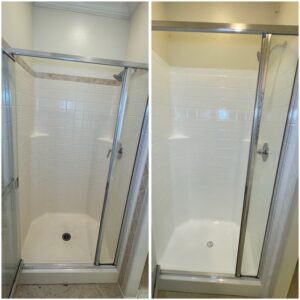
Mold around a shower is one of those things every homeowner has dealt with at some point. It usually starts small — a darker line along the caulking, a faint discoloration where the shower rail meets the wall — and most people just keep cleaning it off and hope that’s the end of it. But once mold starts setting up shop along a shower rail or in the silicone, it has a way of coming back no matter how much scrubbing you do. The mold itself isn’t just sitting on the surface anymore — it’s worked its way into the silicone, and the only real fix at that point is to take the silicone out, treat the area, and start with fresh material.
That was the situation with this Placentia shower stall. The owner had been dealing with mold along the shower rail for a while, and she’d decided she was ready to bring the whole shower up to a fresh start. She also wanted to change the color of the stall to bright white at the same time, which made this a combined mold treatment, refresh, and color change project — exactly the kind of job that lets us bring a tired shower all the way back without anyone needing to demo or replace anything.
The shower itself was in good structural shape. No cracks, no holes, no damage to speak of, no soft spots in the floor. It was a fiberglass unit with an interesting feature — the walls were molded to look like ceramic tile, with the seams and grout-line pattern built right into the fiberglass surface. A lot of homeowners look at one of these and assume it’s a real tile shower, but the entire wall is one molded piece of fiberglass. We see these units in homes all over Orange County, especially in builds from the eighties and nineties when the molded-tile look was really popular. Knowing what you’re actually working with changes the job — there’s no real grout in any of those “lines,” which means no regrout was needed and no actual tile to repair. The whole unit gets treated as one continuous fiberglass surface.
The first thing we did was remove the existing silicone along the shower rail and around the perimeter where the mold had taken hold. Once the silicone was out, we treated the exposed area with an anti-mold product. This step really matters when you’ve got known mold — if you just lay new silicone over an area where mold was living before, you’re sealing in spores that are going to come right back through the new material. The anti-mold treatment kills off what’s there and prevents new growth in the same spot. Taking care of it now, while everything’s open, is the only chance you really get to address it at the source.
After the mold treatment, we moved into a deep cleaning of the entire shower. We worked each of the molded “tile” lines individually with a brush. Even though those lines don’t have actual grout, they’re still where soap residue, body oils, and water minerals collect over time. You can’t just spray cleaner and wipe these down — you have to physically work the brush through each line to lift the buildup out. By the time we were done, the whole shower was back to a clean, neutral surface ready for the next steps.
Once the cleaning was done, we ran fresh caulking along the shower frame and all the way around the unit where it meets the surrounding wall. Putting the new caulk down before the spray means it gets coated along with the rest of the shower, so the final result has a continuous bright white surface from the wall through the shower without a separate caulk bead showing on top.
Then we masked the whole bathroom. Plastic and paper over the floor, vanity, toilet, mirror, fixtures, anything that wasn’t getting sprayed. Masking takes some real time to do well on a shower this size, but it’s what keeps the rest of the room looking clean and untouched while we work. Then we set up our ventilation to pull fumes out of the house during the spray.
For the coating, we sprayed several coats of bright white finish across the whole stall — walls, the molded tile pattern, the floor, all of it — building the coverage up evenly across the unit. When the masking came down, the shower was bright, glossy, and completely transformed from the dated color it had been just hours before. The mold areas along the shower rail were gone, sealed under fresh silicone and treated material. The whole unit looked brand new.
This kind of project is exactly what shower stall refinishing was made for — a unit in good shape, an underlying issue that needed real treatment, and a homeowner who wanted a fresh look on top of it. By handling the mold properly at the source, prepping the unit carefully, and applying a durable new finish, we gave her a shower that’s set up to look great and stay clean for a long time.
If you’ve got a fiberglass shower stall — whether it’s plain panels or one of the molded tile-imitation designs — and you’re dealing with mold, dated color, or just a tired surface, fiberglass shower reglazing is the smart way to bring it back without ripping anything out. We handle shower stall refinishing throughout Placentia and the rest of Orange County, and we’d be glad to come take a look at yours.
For more information you check out our Blog or FAQ.