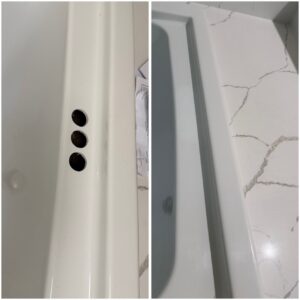
Had an interesting one come in last week out in Brea. It was a new construction house, still being finished out, and the plumbers had cut holes in the wrong spot on the bathtub during their rough-in. Not a huge mistake on paper, but on a brand-new tub it’s the kind of thing that makes everybody on the job site stop and look at each other. The owner called us instead of dealing with a tear-out, which was the right move. Replacing a tub on a new build means pulling the surround apart, scheduling the plumber back out, and pushing the rest of the trades back a week or more. We can usually fix something like this in a single visit.
When we pulled up, the first thing we did was color match. People don’t always realize how many shades of white a bathtub can be. There’s bright whites, soft whites, almost-cream whites, and they all change a little depending on the manufacturer and how old the tub is. If your match is off even slightly, the repair is going to jump out at you the first time the morning light hits it. So we took our time on this part, mixed the coating, tested it, adjusted, tested it again, until it lined up with the surrounding surface.
Once we had the color dialed in, we started on the actual repair. The first problem with a hole in a tub is there’s nothing behind it to push against. You can’t just dump filler in there and call it a day, it’ll sag right through to the back side. So what we do is take plastic spreaders, the kind you’d normally use for spreading filler, cut them down into smaller pieces, and glue them in from the back side of the tub. That gives the repair a backer to work against. Pretty simple trick but it makes the whole job possible. Without that step you’re chasing the filler around the hole forever and it never sets up flat.
Next came the fiberglass filler. This is the structural part of the repair. Fiberglass bonds hard to the tub and once it cures it’s not moving, not flexing, not cracking. We packed the holes full of it and let it set up. At that point you’ve basically got a tub again, just a rough one.
After the fiberglass, we switched over to finish putty and started layering it in. This is the slow part of the job and there’s no shortcut for it. You put down a thin coat, let it dry, sand it flat, put down another thin coat, sand it again, and you keep doing that until the repair sits perfectly flush with the rest of the tub. If you try to rush it and lay one thick coat instead of three or four thin ones, it shrinks as it dries and gives you a low spot that you’ll see forever once the coating goes on. The way I check it is by running my hand across with my eyes closed. If I can feel the edge of the repair, I’m not done. If my hand glides right over it like it’s not even there, we’re good to spray.
Last step was the coating itself. We sprayed our matched color over the repaired area and feathered it out into the surrounding surface. The blend is what makes or breaks one of these jobs. You can do everything else perfectly, but if you spray a hard square over the repair instead of feathering the edges, your eye picks it up the second you walk into the bathroom. Done right, the repair just disappears into the tub.
Customer was happy, the GC was happy, and the build kept rolling without anybody having to swap out the tub. If you’re a builder, a plumber, or a homeowner who’s dealing with a tub that got drilled or cut in the wrong spot during construction, this is fixable nine times out of ten. Give us a call before you order a replacement, you’ll probably save yourself a headache and a lot of money.
For more information you check out our Blog or FAQ.