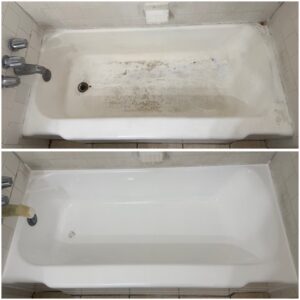
Just finished up a porcelain tub reglazing project in Los Alamitos that turned out to be a little more involved than the homeowner expected — in a good way. The tub had been reglazed once before at some point in its history, and the customer was ready to have it brought back again. Reglazed tubs have a good lifespan when the work is done right, but eventually every finish reaches the point where it’s ready to be redone, and this one had gotten there.
When the customer first called, the scope sounded pretty straightforward — strip the old finish, prep the tub, and lay down a fresh bright white coating. That’s the standard approach when you’re re-reglazing a previously reglazed tub. But once we got into the prep work, we found something underneath the old caulking that we wanted to make sure got handled properly before any new coating went down.
We’ll get to that in a second. Here’s how the whole job came together.
The first step was removing all the caulking around the tub. Standard step on any tub job. Old caulk gets brittle and pulls away from the surface over time, and you can’t lay a new finish over caulk anyway, so it has to come out before anything else happens. We worked our way around the tub and pulled all of it cleanly.
Once the caulk was out, we started sanding down the previous coating. This part takes a little more time on a tub that’s been reglazed before than it does on a factory porcelain finish, because you’re working through somebody else’s coating system that may have bonded better in some spots than others. The goal is to get a uniform, dull surface across the whole tub with no shiny spots remaining. Any glossy areas left behind would be spots where the new coating couldn’t grip the way it needs to. So we worked the whole surface evenly, took our time, and got it ready.
This is the point in the job where we found the situation we hadn’t expected. Underneath the area where the old caulking had been sitting, we found several rust spots on the tub. That’s something that happens on porcelain tubs sometimes — once the porcelain wears through or chips away down to the metal underneath, and water gets to that exposed metal regularly (especially in spots that stay damp, like right at the tub-to-wall edge where the caulk lives), rust starts to form. The old caulking had been hiding it from view. The good news is rust spots on a tub are completely fixable when they’re caught early and dealt with the right way. The important thing is that you don’t just spray over them and hope for the best — you have to actually open them up, get past the affected metal, and seal them properly before any water gets back to that surface.
So we drilled the rust spots out, opening each one up to clean, solid material underneath. Then we filled each cavity with fiberglass body filler. Fiberglass body filler is the right material for this because it bonds hard, cures dense, and once it’s in there it forms a solid barrier between the metal underneath and any water that might find its way down to that area in the future. Critical detail here: we got the rust spots sealed up before any water exposure. That sequence matters. If you let water hit the exposed metal even briefly while the rest of the prep is happening, you give the rust a chance to keep developing and that compromises the repair. So we handled it right away and got the spots sealed before moving forward.
After the rust spots were dealt with, we moved into a thorough deep cleaning of the entire tub. Sanding dust, leftover residue from the caulk removal, body oils, soap film — all of it had to come off the surface before any coating could go down. We worked the whole tub clean and let it dry out completely.
Then we continued working on the chips and the rust spot repairs, sanding everything smooth and flush with the surrounding tub surface. By the time this part was done, the tub was even from end to end — no high spots, no low spots, no visible evidence of the repairs that had just been done. Just a clean, prepped surface ready for the next steps.
We ran fresh caulking all the way around the tub where it meets the wall. Running new caulk before the spray means it gets coated along with the rest of the surface, so the final transition between the tub and the wall comes out looking clean and continuous instead of having a separate caulk bead sitting on top.
Then we masked the bathroom. Plastic and paper over the floor, the vanity, the toilet, the mirror, the fixtures, anything that wasn’t getting sprayed. Masking always takes some time to do properly, but it’s what keeps the rest of the bathroom clean and untouched while we work. Then we set up our ventilation to pull fumes out of the house during the spray. We do this on every job. Keeps the air in the home clear.
For the coating, we sprayed our bright white finish across the whole tub. Multiple coats, building up the depth and gloss evenly, working slowly so every part of the surface got even coverage. We let it cure properly before touching anything.
When we pulled the masking down, the tub looked completely renewed. No more dated finish, no more visible repairs, no more rust hiding under old caulking. Just a smooth, bright white, glossy surface that looked brand new. The customer was really happy with the result.
The thing that made this job satisfying was being able to catch and fix the rust spots properly while we were already in there. Once those were sealed up under fiberglass and locked under a fresh coating, that part of the tub is going to be solid for a long time. That’s the kind of result you can only get when you take the time to inspect what’s actually underneath the old finish before you start spraying.
If your tub has been reglazed before and you’re ready to have it brought back again, or if you’re starting to see worn spots around the caulk lines, give us a call. We’ll come take a look at what you’ve got and walk you through what your tub needs to come back looking new again.
For more information you check out our Blog or FAQ.