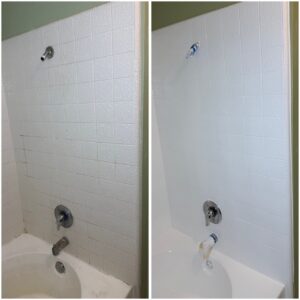
Wrapped up a pretty involved one out in Cypress this week. It was a combo job — ceramic tile surround with an oval fiberglass tub sitting inside it. The owner wanted the whole thing brought back, tile and tub together, which is honestly the way to do it if you’re going to do it at all. Reglazing just the tub and leaving old tile around it is like putting new tires on a car with a rusted-out body. They never look right next to each other.
The tub had been reglazed at some point before we got there. Not a bad job actually, no major damage on it, but the owner wanted everything matching and refreshed. The tile was the real project. Years of soap, water, and shower spray will do a number on grout lines especially, and this one was no exception.
First thing we did was attack the tile with metal brushes. The grout lines are where everything builds up — soap scum, body oils, hard water, all of it settles into those lines and just stays there. Spraying cleaner on it and wiping it down doesn’t do much. You’ve got to physically scrub each line, by hand, with a wire brush, working it into the joint until that gunk lifts out. It’s slow work. There’s no shortcut for it. But if you skip this step, all that buildup is going to sit underneath your new coating and either keep it from bonding or push through it later, and then you’ve got a problem you can’t fix without tearing the whole job back off.
After the brushing, we deep cleaned the entire surface — tile, grout, and the tub. Soap, rinse, soap again, rinse again, until the water coming off the surface ran clean. We also pulled all the old caulk out at this point. Caulk gets brittle and pulls away over time, especially down at the corners and along the tub-to-tile joint, and you can’t lay new finish over old caulk anyway.
Next part was the grout repair. The tile was in decent shape overall but there were spots here and there where the grout was missing or chunked out. Pretty normal on a wall this age. We did a partial regrout — filled in the spots that needed it, smoothed everything out, and let it cure before moving on. No reason to tear out grout that’s still doing its job, but you can’t leave gaps either, because a gap in the grout is going to show right through the new coating once it dries.
Then we ran fresh caulk all the way around the tub where it meets the tile. Doing the caulk now, before the spray, means it gets coated along with everything else. When the job’s finished you don’t have a visible caulk bead sitting on top of the new finish, you’ve got a clean transition that looks like it was always there.
Once the prep was done, we masked the whole room. Plastic on the floor, paper and tape over the fixtures, the vanity, the toilet, the mirror, anything that wasn’t getting sprayed. Then we set up our ventilation to keep the fumes out of the rest of the house during the spray. We do this on every job and it’s not negotiable. Refinishing chemicals are no joke and the customer doesn’t want their house smelling like that for two days.
For the actual coating, we started with a coat of epoxy primer over the tile. The primer’s job here is to seal the grout. Grout is porous — it’ll soak up the topcoat and leave you with dull spots along every grout line if you skip the primer. The epoxy locks it down and gives you a uniform surface to spray over. Once that flashed off, we came in with our polyurethane topcoat. That’s the durable finish, the one that handles daily use, hot water, and standard cleaners without breaking down. We laid down our coats on the tile and the tub at the same time so the whole thing would cure together and look like one continuous surface when it was done.
After everything cured, we pulled the masking down, cleaned up, and walked the customer through it. The bathroom went from a dated, lived-in look to something that honestly could have passed for new construction. Tile and tub matched, no patchy spots, no visible seams between repairs and the rest of the surface.
If you’ve got a bathroom where the tile and the tub are both showing their age, doing them together is the smart way to handle it. You get one cure, one matched finish, and a result that actually looks like it belongs in the same room. Reach out and we’ll come take a look.
For more information you check out our Blog or FAQ.