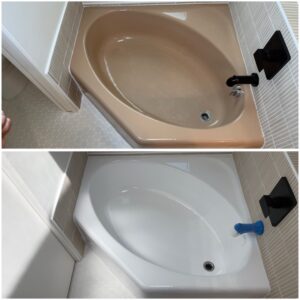
Got called out to a house in La Habra recently for a tub job with a little bit of a different angle than what we usually run into. The customer had a porcelain corner soaking tub — one of those bigger, deeper tubs that sits in the corner of the bathroom and takes up a fair amount of real estate. Nice setup. Tub itself was in great shape, almost no damage, no real wear to speak of. The problem wasn’t the tub. The problem was the color.
The owner had recently put in new tile flooring throughout the bathroom and the new floor changed the whole feel of the room. Brighter, cleaner, more modern. And now the original tub color, which had probably worked just fine before the tile went down, suddenly didn’t fit with anything else. He liked the tub. He didn’t want to tear out a perfectly good, fully functional soaking tub just because the color was off. So he called us about reglazing it in bright white to match the new look.
This is one of the easier sells in our business, honestly. Color-change jobs are exactly what reglazing was made for. Tearing out a corner soaking tub is a major project — you’re dealing with a heavy tub, you’re getting into the surround, you’re probably touching the plumbing, and you’re definitely creating dust and disruption in a bathroom that just got a fresh floor. Reglazing the existing tub gets you the color you want without putting that fresh tile through a demo job. Way smarter move.
When we got out there and looked the tub over, it was almost spotless. The only damage we found was two small chips. Nothing major. We filled them in, sanded them flush with the rest of the surface, and that part of the job was done in pretty short order. You still have to handle chips properly even when they’re small — if you skip them or just spray over the top, they’ll show through the new coating as a visible dimple every single time. So we took care of them right, smoothed everything out, and moved on.
The next thing we usually do on a tub job is pull the old caulking and run fresh caulk before the spray. On this one, though, the grout around the tub was solid. No cracks, no lifting, no soft spots, no gaps where water could be getting through. So we made the call to leave it alone. There’s no reason to rip out perfectly good caulk and grout just to do it again. If it’s stable and it’s sealed, it’s doing its job, and the new coating will sit right on top of it just fine. Skipped the step, saved the customer some time, and moved straight to the prep.
This is something we tell people a lot — we’re not going to add steps to a job just to add them. Every job is a little different. Some tubs need a full repair workup, some need partial regrout, some need fiberglass patches and structural foam. This one needed two chips filled and a fresh coat of paint in a new color. So that’s what we did.
Once the chips were squared away, we masked the whole bathroom. Plastic and paper over everything — floor (especially the brand new tile, which got extra coverage because the last thing we wanted was overspray landing on that), fixtures, mirror, vanity, hardware, all of it. On color-change jobs especially, masking matters a lot, because if even a fine mist of bright white coating settles on the new tile or any other surface, you’ve got a cleanup problem. So we took our time and got it sealed up properly.
Then we set up our ventilation system to pull the fumes out of the house during the spray. Standard practice on every job. Refinishing chemicals are strong, and the customer doesn’t want them sitting in his living room or bedroom while we’re working.
With everything prepped, masked, and ventilated, we sprayed our durable coating over the tub in bright white. Multiple coats, built up nice and even, and let it cure all the way before we touched anything.
When we pulled the masking down and the customer came in to look at it, the difference was night and day. The new bright white tub against the new tile floor pulled the whole room together. It went from a bathroom with two recent updates that didn’t quite match to a bathroom that looked like it had been planned and executed all at once. Way better look.
If you’re partway through a bathroom remodel and the tub is the one thing throwing off the color scheme, you don’t have to rip it out. As long as the tub itself is in decent shape, we can change the color and have it matching the rest of your bathroom in a day or two. Give us a call and we’ll come take a look at what you’ve got.
This one had been around. Lots of damage on it, chips and scratches scattered across the surface, plus a serious buildup of mineral deposits from years of hard water and calcium. Anybody who lives down here knows what hard water does — leaves that white, crusty buildup along the waterline, around the drain, anywhere water sits or runs regularly. Over time it bonds to the porcelain and just becomes part of the surface, and it’s not coming off with a sponge and some cleaner. The owner had been fighting it for who knows how long and was finally ready to have the whole thing redone properly.
First thing we did was pull out all the old caulking. Standard step on every job we do. Old caulk is brittle, it pulls away from the surface, and you can’t lay a new finish over it.
Then we got into the mineral deposits. This is where these old cast iron tubs take some real work. The calcium had to be sanded down and worked off the surface. You can’t just spray over it because the deposits sit up off the porcelain and create high spots that show through any new coating. Plus the calcium itself isn’t a stable surface — coating doesn’t bond to it the way it bonds to clean porcelain. So you’ve got to take the time to work all of that down, level the surface back out, and get the tub back to a uniform base. Slow process but it’s the only way to do it right.
After we got the deposits handled, we went after the chips and the deep scratches. Cast iron tubs with porcelain coating chip in a pretty distinctive way — usually you can see right down to the dark iron underneath where the porcelain has come off. We filled all of those chips, smoothed them out flush with the surrounding surface, and packed in the deep scratches the same way. By the time this part was done, the tub was rough but it was even — no more pits, no more high or low spots, just a uniform working surface ready for the next steps.
Once the repairs were done we ran fresh caulk all the way around the tub where it meets the wall. Doing the caulk before the spray means it gets coated along with the rest of the tub, so when the job’s finished you don’t see a separate caulk bead, you see a clean transition. Looks better and seals better.
Then we masked the whole bathroom. Plastic and paper everywhere — walls, floor, fixtures, vanity, mirror, anything that wasn’t getting sprayed. Overspray will land on every surface in the room if you don’t mask properly, and the customer doesn’t want to spend her weekend cleaning a haze off her bathroom mirror. Better to spend the time taping it off before the spray than dealing with it after.
After that we set up our ventilation. Pulls the fumes out of the house during the spray instead of letting them drift through the rest of the home. We do this on every job. Refinishing chemicals are not something anybody wants sitting in their living room or bedroom for two days.
With everything prepped and the room buttoned up, we sprayed our coating over the tub. Multiple coats, built up nice and even, and let it cure properly. When it was done and we pulled all the masking down, that old beat-up tub was a bright, glossy white again. No more chips, no more calcium streaks, no more dark spots showing through. Just a clean, smooth surface that looked like it could’ve come out of the factory yesterday.
The thing about cast iron tubs is they’re worth the work. You don’t replace one of these — you bring it back. The body of the tub is going to outlast you, the next owner, and probably the one after that. All you need is the surface brought back every couple decades, and you’ve got a tub that’s better than anything new you could buy.
If you’ve got an old cast iron tub in your house that’s looking rough, chipped up, scratched, or covered in mineral buildup, give us a call. There’s a good chance it’s a much better tub than you think it is, and we can have it back to looking new without you having to rip out half your bathroom to replace it.
For more information you check out our Blog or FAQ.